
What a Long Strange Trip It's Been
Six years in and Discord went from a gaming walkie-talkie to a global platform.
Uphill Both Ways
Early Discord was rough.
Anyone who used it before ~2017 remembers: voice died the second you had over a dozen users connected simultaneously, moderation tools were almost non-existent, themes changed constantly, and server discovery was a fiction. The platform shipped fast and broke everything along the way.
Discord? It’s like Skype, but better...
It really was like Skype and Slack had a kid, except the kid was smarter than both parents and already knew TeamSpeak had failed its “community interactivity” exam.
You can’t fit a square peg in a round hole.
Sure you can, you just make the peg smaller.
Know Your Roots
An online community lives on organic discussion and interaction until it doesn’t. The second it switches up, trust dies and never comes back. There had to be greener grass, and if my crew and I couldn’t find it, we’d have to build it.
Forums weren’t new to me; owning one was. I was never that good at math, but could confidently calculate this was going to be an uphill battle.
Getting people to move is one of the most difficult things you can do within online communities. Users hate change, myself included, and begging never works; you just get quote pyramided endlessly with smileys.
Only two things separated what I could do on Discord from everyone else.
Care, and never sell out.
News that KanyeToThe had been sold to VerticalScope made its way across DMs, removing the last bit of faith left. That push was all it took.
Friends IRL clowned my love for hip-hop; the conversation moved online and stayed. Every few years, whichever community felt most like “home” sold out, got bought, or imploded due to careless admins. Clockwork.
The goal was simple: a space where the only thing anyone judged was your Top 10. Not ethnicity, not your GPA, not which way you swing. A fandom can exist around a subject, but a community only exists around the people in it. Build for the subject alone, and it dies the moment the subject gets boring. Build for the people who create the culture, and they become autonomous.
There’s an academic term for what fans do in spaces like this: participatory culture. Fancy way of saying fans aren’t just consuming, they’re building. The in-jokes, the slang, the entire social architecture; fans generate all of it. What the academics don’t write about is who shows up to collect once the building’s done, or what happens to the builders when someone who never held a brick starts managing the site.
On the evening of September 25, 2016, I launched HHD (Hip-Hop Discord).
Something was there, unmistakable, and everyone from my clique felt it. Only the scale was unknown.
Talk is Cheap, Chat is Cheaper
With almost no built-in moderation tools, growth showed up hand-in-hand with chaos. Slowmode did not exist, but raiders did.
It quickly became meta to interact with them. Sometimes it felt like virtual turf wars; regulars began to play personas, shitposting strategically, asking wanderers for “train tickets” or “admission slips” to join channels that did not exist. One guy showed up every night for two weeks just to type “L” in general chat before getting banned. The mods started greeting him by name.
Culture grew from the chaos, not despite it.
The server never needed 24/7 high-brow conversations. It just needed to feel alive.
One real rule existed: show up every day. Not because someone was watching, but because every user who walks in is silently asking why they should return tomorrow. You answer that question through the way you maintain the space; it gets answered daily whether you like it or not.
Ask Me Anything
Reddit nailed the AMA format. I took it, ran with it, and brought it to Discord—real-time text AMAs for hip-hop. Chaotic and inefficient as you’re imagining.
The first guest was Stanley “Substantial” Robinson, a DMV-based artist, educator, and one of the earliest collaborators of the late Seba “Nujabes” Jun. A month after launch, a text AMA went live. Then another. Anyone with a story was welcome.
After about a dozen text runs, the format leveled up to voice. No more just reading answers; live timing, awkward pauses, all of it became part of the experience. Inside jokes, memes, poking fun at both hosts and guests.
Discord’s voice stack improved. Everything looked ready.
Then Pusha T showed up.
The Exact Moment
Word about HHD eventually reached Summer Watson, Pusha’s long-time business partner. A few messages later, a time was set. No agenda, no promo, no plug required.
Pusha wanted to understand what this “Discord” thing was, how a hip-hop community was thriving on a gaming app, and to be there before it blew up.
7PM, August 8, 2018. Drake was still riding Scorpion, Astroworld had just dropped the same week, and the Pusha-Drake beef had turned every hip-hop conversation on the internet into a referendum on authenticity. Fitting backdrop.
1,700+ people queued up in voice channels, with hundreds more in overflow. We made a taped-together relay system because voice channels had limits far below the number of people trying to get in. A recent move IRL meant internet was live but only an old Chromebook was available; no desktop, no backup plan.
The instant Pusha joined, the server melted. Thousands of messages per minute.
Phone frozen. Chromebook frozen. Audio became the only lifeline, which was also frozen. Texts and calls to my crew weren’t going through; connection was spotty and everything teetering on collapse.
Audio distorted into an endless static. A relay channel bought a few minutes of sanity; then everything tapped out. Server dead, then alive, then dead again.
Complete chaos.
On paper, a technical disaster and the nightmare of many.
In reality, impossible to stop smiling. Everyone including Summer and Pusha knew something was in the water here; the only question was how to wrangle it.
Corporations Cometh
Discord has now been in the wild for six years, three since the Pusha chaos, and has rebranded away from gaming into a generalized chat platform.
The platform’s potential for real dialogue in music was obvious from the start. Internal pushback from staff, warnings about bandwidth and risk, and AMAs being frowned upon were just corpospeak; the people building the product knew better.
Now the suits show up.
For most major-label teams, Discord remains alien terrain; someone has to walk them through it.
Hip-hop especially is a culture that must be lived. I’ve watched A&R reps confuse Griselda with Dreamville in a pitch meeting and still expect to run a hip-hop server. That’s the talent pool.
Spotify proved in ‘18 with a partnership that music has a place on the platform. Corporate-backed communities are another story entirely; the majority of brands want to spray a message, farm a metric, and leave. Launch loud, go quiet, then ghost. The server stays online, and the users bounce.
The question isn’t whether they sell out. It’s whether they know what they’re actually selling.
Selling Out
Corporate presence at scale is a double-edged sword: exposure on one side, authenticity loss on the other, and no reverse gear. Think Steam in its adolescence.
At some point, Discord has to pick which side of that blade it’s willing to hold when the acquisition closes or the IPO bell rings.
The monetization route doesn’t require genius to see. Facebook, Reddit, mobile games already ran the playbook: you don’t monetize the conversation, you monetize the costume.
The platform will inevitably sell identity to users, and in whatever flavor they want:
Profile picture frames and avatar decorations (like Facebook, but paid)
Seasonal flairs and themed collections (Naver has done this for years on its Blog platform)
Username and role-icon theming (like old-school forums, but modern)
Profile effects (like Steam did this past year with Steam Points Shop)
Client skins like DOTA2
More tiers of Nitro, up or down
Dedication rewards, streak badges, digital collectibles (Duolingo, anyone?)
Eventually, some form of engagement-driven virtual currency shows up: earned through paid CTAs, redeemable for cosmetics and subscription credits.
The corpospeak term for this is “earned, not purchased.”
Identity is social currency in any online community, and when it can be bought to boost status, regulars swipe. Years in esports back that instinct up. Scrappy to manufactured, but larger than anyone expected; big sponsors, money pouring into teams, seven-figure prize pools. Any prediction of that in 2010 would’ve sounded like a joke. K-pop’s climb from subculture to export machine is the same trajectory; every piece of K-media that goes viral adds eyeballs that never leave. Give it five years. Esports did plenty of good. The truly grassroots version is mostly gone. That’s the trade-off, and it’s the same one Discord will have to make.
More than two dozen conglomerates, majors, and assorted players have reached out to me directly with some mix of: free or paid promotion, offers to buy the server, guest booking pitches, and quiet astroturfing angles to make their presence “feel” organic.
Most take the cash. Business without roots wouldn’t be hip-hop, it’d be greed, and I live hip-hop.
A few reps openly admitted this was part of a wide campaign across hundreds of servers. The quiet part isn’t even quiet anymore; it’s a checkmark on someone’s social strategy.
Take any offer large enough to make this particular server fold, write that number on a piece of paper, and hand that same number (or a fraction of it) to a younger owner looking for a quick bag. Now the logo and owner stay the same, but the agenda quietly changes.
A subtle push of one label’s artist over another, a generic meme that gently sways opinions over time, a content strategy calculated with precision to appear genuine. The shape of the server shifts, and nobody voted on it.
Regulars can always sniff this out. Even if you think you’re slick, you aren’t.
The moment the person making decisions about a space stops being the person who lives in it, the space starts dying. Doesn’t matter if it’s a forum, a server, a record label, or a league. Fans show up, build something worth caring about, and the culture they generate catches someone’s attention. Then someone with no stake in any of it acquires control, and every decision optimizes for the view from outside the room instead of the experience inside it.
The community doesn’t die from neglect. It dies from management.
I look at hip-hop as an art form. It was a voice of the people. You can go wherever you want but if you leave the roots, and to me the roots are the voice of the people, you lose your soul. —Chi Modu
If Discord walks away from its own roots, what’s left is anyone’s guess.
Discord’s Secret Weapon: Stages
Since 2016, a single-page pitch called “The PDF” has done all the heavy lifting for HHD’s AMAs. Artist teams, PR, anyone remotely relevant: it all started there. Easily more than a thousand emails sent.
Names came from scraped bios, old interviews, dusty tweets. Most ignored it. Some replied only to say Discord didn’t “fit our vertical.”
Many of those same majors and creators now quietly operate Discord servers of their own.
No backing, no sponsor, no budget. Just that PDF. Just under 100 AMAs hosted. Every guest and event on HHD traces back to that one page.
Then Discord shipped Stages.
Stages is a built-in stage/host format for live audio; in-app Clubhouse without the velvet rope or snobby atmosphere. The platform’s biggest strength has always been in-app reach, not its Twitter, TikTok, or YouTube presence. Lean into the users already here and new users follow on their own.
Once Stages came into play, visitation on HHD jumped 1,107.9% in a single week. The largest day-to-day spike since the server’s creation. Nothing else has come close.
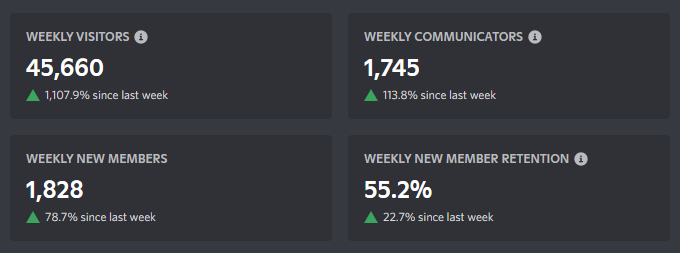
Stages work. The conversations people actually want are the ones that can't be replayed, clipped, or optimized after the fact. Live, messy, real. Discord already has the users and the technical infra. The goldmine is sitting right there, and the window to mine it won't stay open forever.
Don’t Let It Slip
Instead of leaning into what Stages proved, the platform is securing brand collabs and calling it music strategy. Servers for The Weeknd or Eminem where it’s obviously an intern pushing NFTs through an artist-branded account do more damage than good. The Cactus Jack collaboration with Travis Scott was deleted from Twitter for reasons unknown.
Discord is a company with hundreds of millions in funding and a multi-billion dollar valuation, and the best it can do for music is a branded server that goes dark after three months. Real conversations—the type that only happen when artists, fans, and live audio collide—can’t be manufactured and sold back on a content calendar. You can fake spontaneity, but you can’t monetize it. The audience knows.
HHD proves what happens when someone who actually lives in the culture runs the room. No budget, no sponsor, no partnership deck. A PDF and a decade of caring about the same thing every single day.
Music has real depth, and Discord barely scratches it.
Chi Modu
In early 2018, a virtual link-up for a piece turned into an ongoing exchange, and eventually an IRL meetup. Most evenings on the way home from work turned into shaky long-exposure attempts on a phone at crosswalks, sent straight to his inbox. The shots weren’t good, but feedback was always kind, honest, and paired with small tips.
Late 2019 brought a trip to NYC. On the very last day in the city, Chi agreed to meet.
He walked in with UNCATEGORIZED shrink-wrapped under his arm, a Sharpie, and a small bag.
“Let’s do this,” he said.
Two hours vanished. Hip-hop. The city. Stories from his favorite shoots, behind-the-scenes shots on his phone.
“What you see is 1% of what I have in the vault.”
Lunch was on him. The book got signed. Then came the line that killed the thought of quitting HHD after years of feeling stuck:
You see the beauty in this city, in its flaws. That’s rare these days. I can tell you genuinely love hip-hop.
A joke about escaping the noise to Jersey City and a prediction that anyone who really loved the city would eventually do the same. As the meeting wound down, a Leica M3 came out of the bag. The strap wrapped around his wrist, lens turned inward.
“...mind if I get some for the road?”
A few quick frames later, selfies with the GOAT.
“I’ll send these in a few. Until next time. Peace!”
That moment replayed on loop the entire flight home.
That anecdote has been pitched to nearly a dozen well-known music outlets looking to feature HHD.
None ran it. “Irrelevant.”
Once things turn corporate, traffic outranks meaning. Culture gets filed under “not a fit.”
So it lives here as an ode to a legendary documentarian who inspired the way I move through hip-hop and music itself. Chi influenced people every day, even when the story behind the image never made it to print.
The Formula
Community cannot be forced. It takes time; more than anyone ever budgets for.
HHD is far more than just a Discord server. It is also just a Discord server. I’d do it all again.
Whatever Discord becomes, the only thing that matters is who’s still building for the people, no one else.
The people who were here before any of it mattered will also be here after it all stops mattering.
You’ll never see that part in a pitch deck.